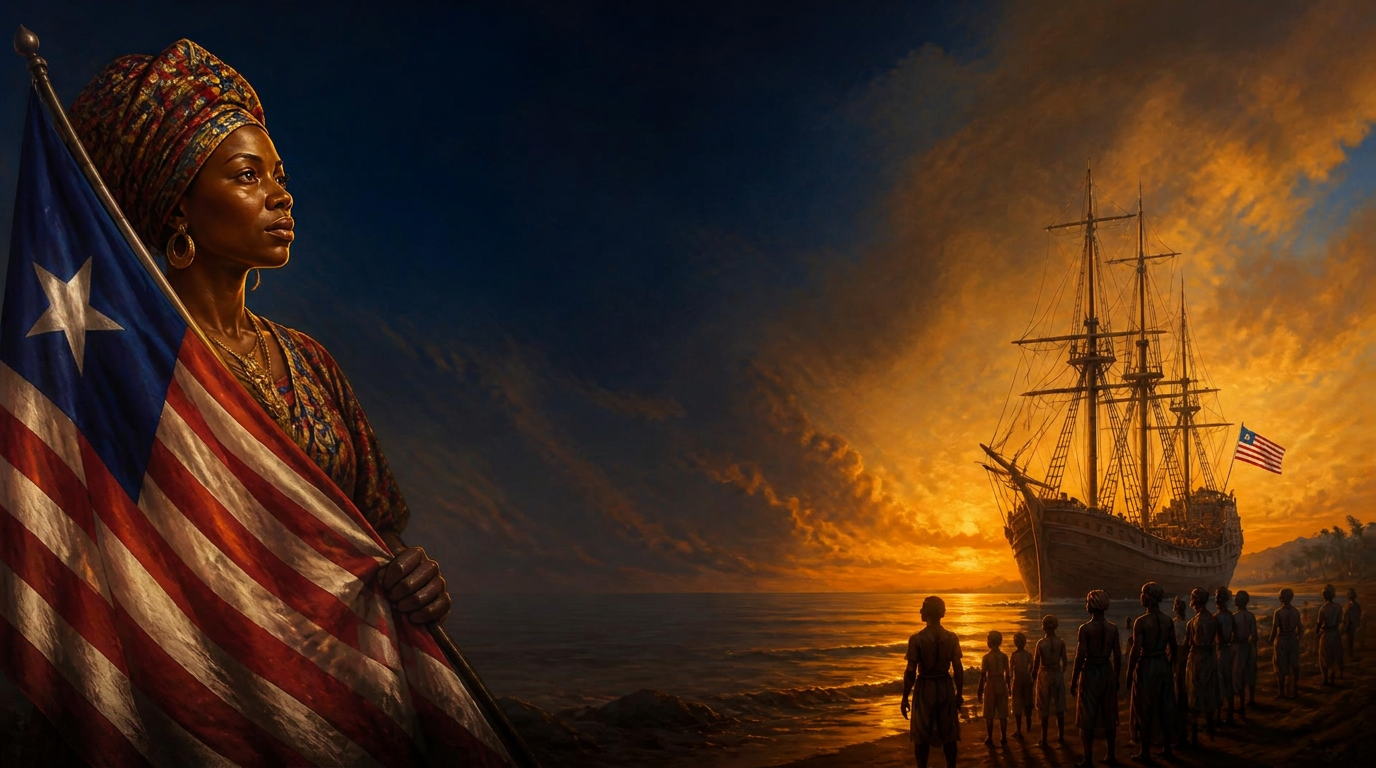
Discover the ancient kingdoms, empires, and people that shaped Liberia before 1822.
Vibrant culture
Explore the traditions, languages, beliefs, and heritage of our ancestors.
Untold stories
Uncover the journeys, struggles, and triumphs never told in history books.
Preserving legacy
Honoring our past to inspire future generations of Liberians worldwide.
Advance praise
“A landmark contribution to Liberian historical scholarship.”
Advance praiseEndorsement to be attributed on publication
“Restores the kingdoms, confederations and trade systems of the Liberian interior to the record they were written out of.”
Advance praiseHistorian of Upper Guinea — attribution on publication
“Scrupulous about its evidence: it tells you where the record is firm, where it is debated, and where it rests on oral tradition.”
Advance praiseArchaeologist and museum professional — attribution on publication
Endorsements are shown unattributed until publication, when they will carry the names and affiliations of the historians, archaeologists and cultural institutions giving them.
“A landmark contribution to Liberian historical scholarship.”
Advance praise
I — The argument
About the book
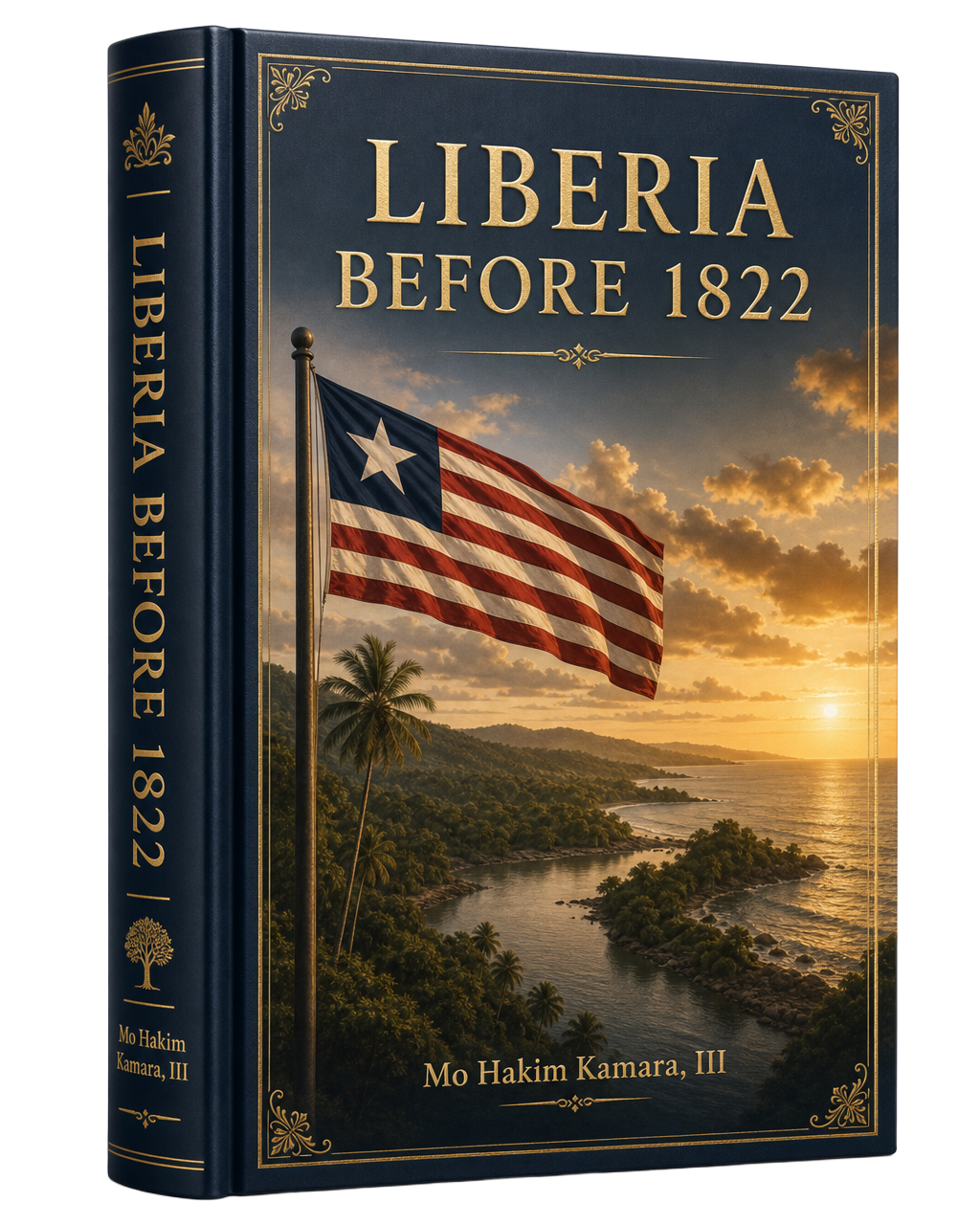
“Liberia Before 1822” is a groundbreaking work that takes you on a journey through time, revealing the rich history of the land and peoples that existed long before the arrival of American settlers.
The volume moves in three movements, mirrored below: first the peoples and polities of the coast and interior; then the sovereigns who governed them on the eve of contact1,8; and finally the 1820 voyage of the ship Elizabeth, the arrival that closes the pre-1822 era13,14.
Each claim below carries a numbered marker; tap it to jump to the full citation in the apparatus at the foot of this page.
Sixteen peoples, four language families, the towns that mattered and the roads that joined them to the western Sudan and the Atlantic. Tap a territory, a market or a trade road.
1822 CE16 of 16 peoples settled
800 CE1822 CE
Territories fade in at their estimated period of arrival. Dates are reconstructive — a settled presence emerges over generations, not in a single year.
Reconstructive cartography. Territories are drawn as soft zones because pre-colonial polities held frontiers rather than borders. Squares mark capitals, circles ports and markets; dashed lines are principal trade roads.
Two and a half thousand years
From the first bloomery furnaces of the forest margin to the flag raised on Cape Mesurado in April 1822. Scroll the axis and tap any marker.
Colonisation · 25 April 1822
Settlement at Cape Mesurado
The settlers raise their flag on Cape Mesurado after the crisis of that April is mediated by Sao Boso and King Brister. The pre-1822 world does not end here — but the record of it changes hands, and this volume closes.
Sources: Ashmun, in Captan 2015; ACS correspondence
Before the settlers, Liberia was a land of kingdoms, confederations, and sovereign rulers — strategists and diplomats whose names deserve to be remembered. Here are a few whose courage and statecraft this book restores to the record6,8. Six of them set their marks to the Ducor Contract of 15 December 1821 or mediated the crisis that followed it2,4.
Listed in the order they enter the documentary record. Every card carries its dates and a citation; tap “View references” for the full apparatus.
King Sao Bosso Kamara
Condo Confederation · Mandingo sovereign of Bopolu
fl. c. 1780s–1830s · d. before the 1860s
Mandingo ruler of the Condo Confederation, whose capital at Bopolu (Bokoma) lay a hundred miles inland and dominated the trade road from the far interior to the coast between the Lofa River and Cape Mesurado. Europeans called him 'Boatswain' after the rank he once held aboard their ships. In the 1822 crisis on Cape Mesurado he marched to the coast and mediated between the settlers and the Dey, Gola, and Vai — backing the bargain already struck. In 1834 he received a settler delegation and agreed to supply the colony with cattle, rice, and ivory. His son Momoru Sao ruled Bopolu into the 1860s.
Holsoe 1971; Abe Kromah 2016; Captan, Introduction to Liberian Government (2015)
King Jimmy
Dei chief · St. Paul River · treaty signatory
fl. 1821–1825
A Dei chief of the St. Paul River, and one of the six 'kings' who set their marks to the Ducor Contract of 15 December 1821 — the founding deed of Liberia, drawn up aboard the U.S. schooner Alligator. When the settlers returned in May 1825 he was among the five kings at Gourah on Bushrod Island who insisted that any further wild land between the St. Paul's and Montserrado Rivers could only be taken after a conference of the kings and an equitable settlement.
Ducor Contract, 15 Dec 1821 (Indiana Univ. Liberia Coll.); 11th ACS Annual Report (1828), pp. 63–64; Burrowes, Smithsonian (2023)
King Zolu Duma
'Peter Careful' · ruler of the Southern Vai & Gola
c. 17??–1827/28
Raised among the Wuling of the Bassa, he rose to power as a trader and built a state over the southern Vai and neighbouring Gola, with its capital at Gon on the North Lofa River. In December 1821 he sat with Stockton and Ayres over the Cape Mesurado land; he tried to withdraw once he grasped that a permanent settlement would choke the slave trade, and was forced to cede the ground at pistol-point. He held a treaty of friendship and non-aggression with Sao Boso by about 1827. He died in 1827/28 and was succeeded by his son Jalla Fingue ('Prince Peter').
Holsoe, 'Zolu Duma…17??–1828' (Liberian Studies Journal, 1990); Dunn, Beyan & Burrowes, Historical Dictionary of Liberia (2000); Bayard, Life of Stockton (1856)
King Jack Ben
Jumbo Town · Grand Bassa
fl. c. 1800s–1820s
The leading figure of the Bassa coast, whose town of Jumbo was a node where ivory, pepper (grain of paradise), and woven goods changed hands long before any settlers' flag flew. When the American Colonization Society could find no landing in Sierra Leone, it was King Jack Ben who 'provided the contacts' that led the agents to Cape Mesurado and the December 1821 bargain. He governed the harbours and middlemen of a busy Atlantic trade on his own terms.
Republic of Liberia, TRC Final Report, Vol. II; Sumaworo, 'Critical Analyses of Liberia's Bicentennial' (IJCSRR, 2022)
King Brister
Dei ruler · the Mesurado interior
fl. 1822–1840
A Dei leader of the Mesurado interior who, alongside Sao Boso, stepped in as a mediator when the subordinate chiefs rose against the sale of their land — 'no one, not even the King, has the right to sell the land which belongs to all of us.' The crisis was settled on 24 April 1822 through his and Sao Boso's intervention. He remained a man to be reckoned with: in April 1840 he was among the kings who signed Governor Thomas Buchanan's treaty of perpetual peace and the end of slave-trading in their jurisdictions.
Captan (2015), citing Ashmun; National Gazette and Literary Register (Philadelphia), 31 Jul 1840; Sumaworo (2022)
King Long Peter
Gola chief of Klay · treaty signatory
fl. 1821–1825
A Gola chief of Klay and a signatory of the Ducor Contract of 15 December 1821, by which the kings of the Mesurado country ceded a strip of coast to the American Colonization Society. Like his fellow kings, he understood the bargain as one of shared use and reciprocal obligation rather than permanent alienation — and in May 1825 he was back at Gourah on Bushrod Island, insisting that no further land between the St. Paul's and Montserrado Rivers be taken without a conference of the kings and an equitable price.
Ducor Contract, 15 Dec 1821; 11th ACS Annual Report (1828), pp. 63–64; Burrowes, Smithsonian (2023)
These are only a few of the sovereigns, war leaders, and negotiators whose full stories unfold across the chapters of this volume.
III — The arrival, 1820–1822
The Voyage of the Elizabeth
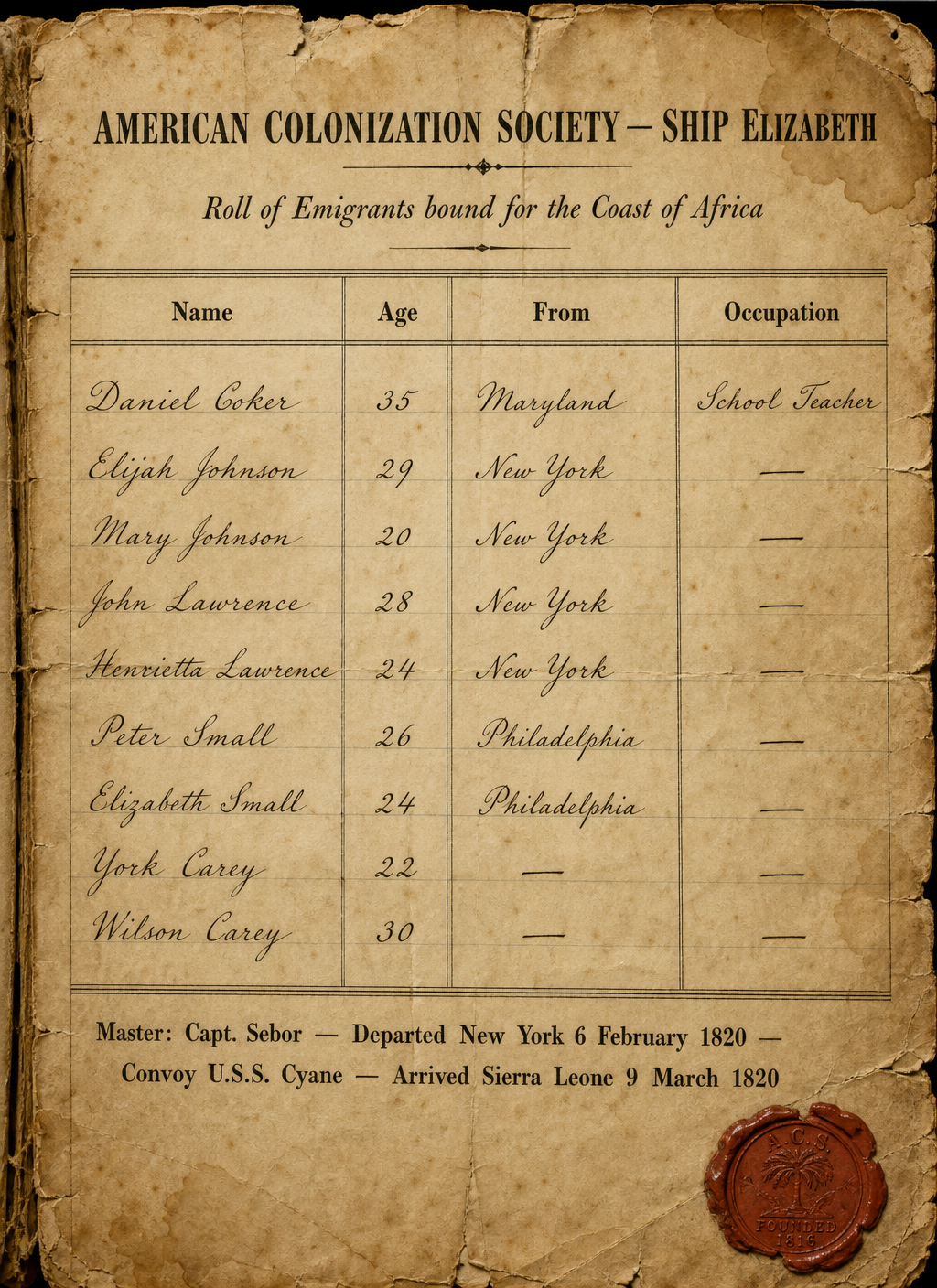
The pre-1822 era ends where this manifest begins. On 6 February 1820 the American Colonization Society ship Elizabeth cleared New York harbor with eighty-six emigrants and three agents aboard — the voyage later called the “Mayflower of Liberia”14. She sailed under naval convoy and reached Sierra Leone on 9 March 182013. The primary record below is reproduced from ACS documents and Daniel Coker’s shipboard journal13,14; the land the emigrants would later occupy was still governed by the kings above4,7.
Facsimile of the Elizabeth manifest, Master Capt. J. B. Sebor, New York, 6 February 182014.
6 Feb 1820DepartureNew York harbor — 86 emigrants set sail under the ACS flag.
Feb–Mar 1820ConvoyEscorted across the Atlantic by the U.S.S. Cyane, Commodore Perry.
9 Mar 1820ArrivalFourah Bay, Sierra Leone — the party lands 31 days out of New York.
Ship Elizabeth · Master Capt. Sebor
Passenger Manifest
Departed New York 6 February 1820, convoyed by the U.S.S. Cyane, arriving Sierra Leone 9 March 1820. Eighty-six emigrants set out under the American Colonization Society flag — the founding voyage, later called the “Mayflower of Liberia.” Tap any name to read their age, origin, role, and notes.
Emigrants and agents aboard the ACS ship Elizabeth, 6 February 1820
Name
Age
Origin
Role
Daniel Coker
35
Baltimore, Maryland
Schoolteacher & lay minister
Elijah Johnson
29
New York
Colonist & soldier
Mary Johnson
20
New York
Colonist
John Lawrence
28
New York
Colonist
Henrietta Lawrence
24
New York
Colonist
Peter Small
26
Philadelphia, Pennsylvania
Colonist
Elizabeth Small
24
Philadelphia, Pennsylvania
Colonist
York Carey
22
United States
Colonist
Wilson Carey
30
United States
Colonist
Rev. Samuel Bacon
—
Pennsylvania
ACS agent & expedition leader
John Bankson
—
Pennsylvania
ACS assistant agent
Rev. Samuel A. Crozer
—
Pennsylvania
ACS assistant agent
Notes for each passenger are available by tapping the name in the list above.